Project Progress Report
| Workshop Event | TBrainBoost Workshop 6.0 (Pre-Summer School Series) |
| Delivery Mode | Five-day online workshop with offline homework and independent follow-up work |
| Lead Facilitator | Paul De Roos |
| Organizers | Prof. Dr. Uroš Marušič; Paul De Roos |
Executive Summary
TBrainBoost Workshop 6.0 was delivered as a five-day online pre-summer school series designed to prepare students, researchers, and academic experts for the main summer school programme. The workshop combined guided instruction, interactive exercises, and independent homework so that participants could continue learning offline between sessions. The overall aim was to strengthen research framing, evidence synthesis, critical AI use, and applied learning strategies before the summer school began.
Across the five days, participants progressed from alignment and preparation to applied work in AI-supported research, AI in learning, and literature search strategies. The structure encouraged continuous engagement: each online meeting introduced concepts and practice tasks, while homework assignments reinforced the material through offline individual work and reflection.
Workshop Structure
| Day | Format | Main Focus | Offline Follow-Up |
| Day 1 | Online | Orientation, cohort alignment, and baseline preparation | Participants reviewed the roadmap and prepared for subsequent activities |
| Day 2 | Online | Continuation of preparatory work and multidisciplinary alignment | Students consolidated background knowledge and completed preparatory tasks |
| Day 3 | Online | Using AI in research | Homework focused on refining research questions and literature workflows |
| Day 4 | Online | AI in learning | Participants applied reframing and prompting exercises independently |
| Day 5 | Online | Literature search strategies | Students practised search logic and evidence review offline |
Detailed Overview of the Five-Day Series
Day 1-2: Preparatory and Alignment Phase
The first two online days were dedicated to preparation and alignment activities. Under the guidance of Prof. Dr. Uroš Marušič, Asist. Prof. Matevž Vremec, and neurologist Paul De Roos, the cohort established a shared starting point, clarified expectations, and aligned the clinical, technical, and scientific perspectives represented in the group.
These opening sessions focused on building the foundations needed for the rest of the workshop. Participants were introduced to the competencies required for the pre-summer school pathway, familiarized with the overall roadmap, and supported in identifying the core questions and methods that would guide their work during the following days.
Between sessions, students were assigned homework and independent reading to reinforce the preparatory material and to ensure they arrived at the later workshops ready to engage more deeply with the applied content.
Day 3: Using AI in Research
The third day, led by Paul De Roos, focused on the responsible and structured use of AI in research. Participants worked through the anatomy of a strong research question, using the FINER criteria to distinguish what was established from what still required investigation.
A major theme of the day was the need to avoid the agreement trap. The workshop showed how AI systems can produce fluent but insufficiently critical responses, and participants practised prompting strategies that force models to generate counterarguments, surface missing evidence, and test assumptions.
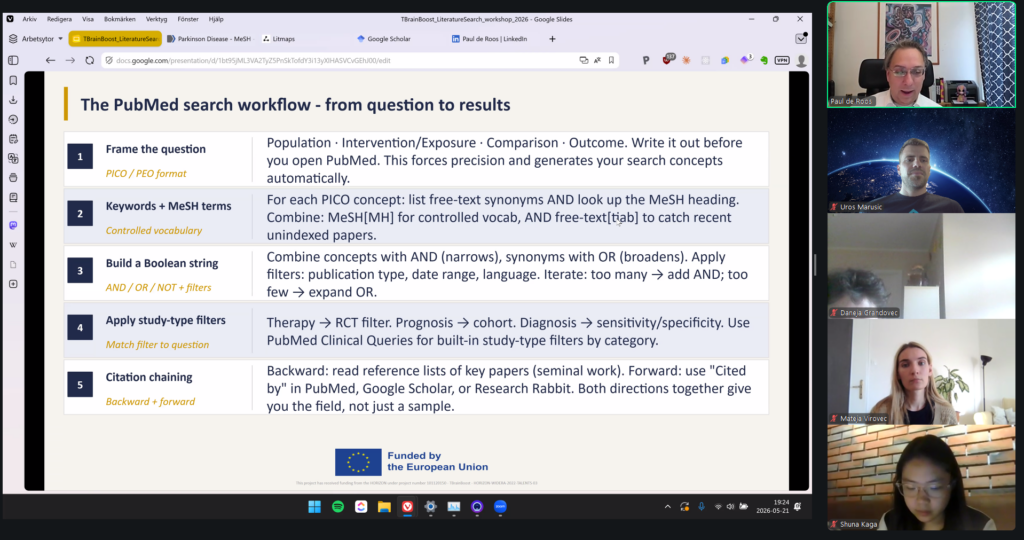
The session also covered structured literature workflows, including PICO decomposition, search-string design for PubMed, abstract screening, and data extraction into evidence matrices. Additional guidance was provided on AI-supported data visualization and on the verification standards expected when using generative tools in evidence synthesis.
Homework after this session asked participants to refine their own research questions and develop a more disciplined literature workflow for offline continuation.
Day 4: AI in Learning
The fourth online day explored how AI influences learning, cognition, and problem solving. The session connected educational theory with practical prompting methods to help participants work more effectively with complex scientific and clinical challenges.
Key frameworks included Kolb’s learning cycle, the Design Council Double Diamond, Bjork’s desirable difficulties, Sweller’s cognitive load theory, and Mezirow’s transformative learning. These ideas were used to show why productive friction, careful problem framing, and cognitive reorganisation matter when AI is used in educational and research settings.
The workshop addressed wicked problems and multidisciplinary teamwork, including situations where engineers, clinicians, designers, and researchers speak in parallel rather than in a shared problem language. Participants practised reframing prompts, assigning roles and stakes, requesting explicit disagreement, and iteratively refining questions to produce more useful outputs.
Offline tasks extended the learning process through individual reflection and application of the prompting techniques to real examples from the participants’ own contexts.
Day 5: Literature Search Strategies
The final online day concentrated on literature search strategy and evidence retrieval. Participants translated research questions into searchable elements, combining PICO structure, free-text synonyms, and controlled MeSH vocabulary to improve search quality in PubMed and related databases.
The workshop also introduced strategic reading techniques and journal-quality assessment approaches, helping participants decide how to read efficiently based on their goal and how to interpret indicators such as Impact Factor, CiteScore, and Scimago quartiles.
A central message of the day was that AI search tools alone are not sufficient for comprehensive evidence retrieval. The workshop compared different approaches to recall and showed why combining database searching with manual citation chaining produces far more complete results.
The session concluded with a mapping of appropriate tools to research tasks, including search strategy development, screening and extraction, citation auditing, mapping, and reference management. Homework supported continued independent practice with these tools after the online meeting.
Conclusion
TBrainBoost Workshop 6.0 provided a coherent five-day online learning journey that moved participants from preparation to applied methodological work. The mix of online instruction, structured exercises, and offline homework created continuity between sessions and helped students continue learning independently throughout the week.
By the end of the series, participants had strengthened their capacity to frame research questions, use AI critically, search the literature systematically, and carry out disciplined follow-up work outside the live sessions. This created a strong foundation for the main summer school activities that followed.